

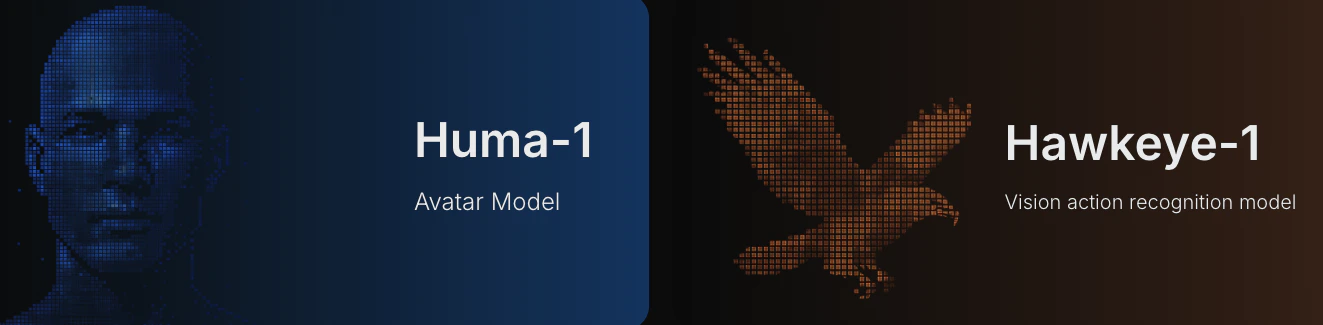
Huma-1 — Expressive Avatar Model
Huma-1 is TruGen’s neural avatar renderer. It generates photorealistic video frames synchronized with speech, producing lifelike facial expressions, micro-expressions, lip sync, gaze direction, and emotional nuance in real time. Best for- Face-to-face conversational agents where realism matters
- Multi-language avatars that must maintain natural expression across accents
- Interactive product demos, interviews, coaching, and support experiences
Hawkeye-1 — Vision Action Recognition Model
Hawkeye-1 is TruGen’s vision layer. It continuously analyzes the user’s video stream to understand appearance, environment, screen shares, and visual cues, feeding this context into the LLM so responses stay grounded in what the agent can actually see. Best for- Agents that must react to user actions (holding up a document, pointing at a screen)
- Multimodal experiences where context beyond audio matters
- Screen-share aware assistants and visual troubleshooting flows
How they work together
The two models are complementary — Hawkeye-1 handles perception (what the agent sees), and Huma-1 handles expression (how the agent responds). Combined with the pipeline’s STT, LLM, and TTS stages, they enable agents that see, hear, understand, and respond with sub-second latency.Pipeline Architecture
See how Huma-1 and Hawkeye-1 fit into the end-to-end conversational pipeline.
Create an Agent
Spin up your first agent using these models.