> ## Documentation Index
> Fetch the complete documentation index at: https://docs.trugen.ai/llms.txt
> Use this file to discover all available pages before exploring further.
# Models
> The foundation models that power TruGen's real-time video agents.
TruGen's conversational video agents are built on a family of proprietary foundation models — two generations of avatar renderers (Huma-2, Huma-1) and a vision action recognition model (Hawkeye-1) — that work together to deliver human-like, real-time interactions.
## Huma-2 — Real-Time Interactive Avatar Model
Huma-2 is TruGen's next-generation real-time interactive avatar model, built for seamless, human-like conversations. It generates high-fidelity facial animation powered by **Gaussian Splatting**, chosen because it's fast enough for real-time use, flexible enough for audio-driven deformation, and trainable from short video clips.
**Best for**
* Sub-second, face-to-face conversational experiences where every millisecond of latency matters
* Avatars trained from minimal source material — only 2–3 minutes of pre-recorded video in a controlled setting
* Production deployments that need robust performance across varying audio and recording conditions
**Key characteristics**
| Attribute | Detail |
| -------------------- | ------------------------------------------------------------------ |
| Modality | Real-time interactive avatar generation |
| End-to-end latency | Sub-500 ms |
| Rendering | Gaussian Splatting for audio-driven facial deformation |
| Training data | 2–3 minutes of pre-recorded video |
| Runtime architecture | Two-phase — preloading + inference — to minimize perceived latency |
**What's new vs. Huma-1**
* **Leaner models** — internal networks redesigned to be significantly smaller, delivering faster inference with negligible accuracy trade-offs
* **Streamlined data path** — unnecessary pre-processing stages removed, producing leaner boot sequences and faster load times
* **Robust audio encoding** — enhanced tolerance to varying recording conditions, reducing sensitivity to input quality and simplifying data collection
## Huma-1 — Expressive Avatar Model
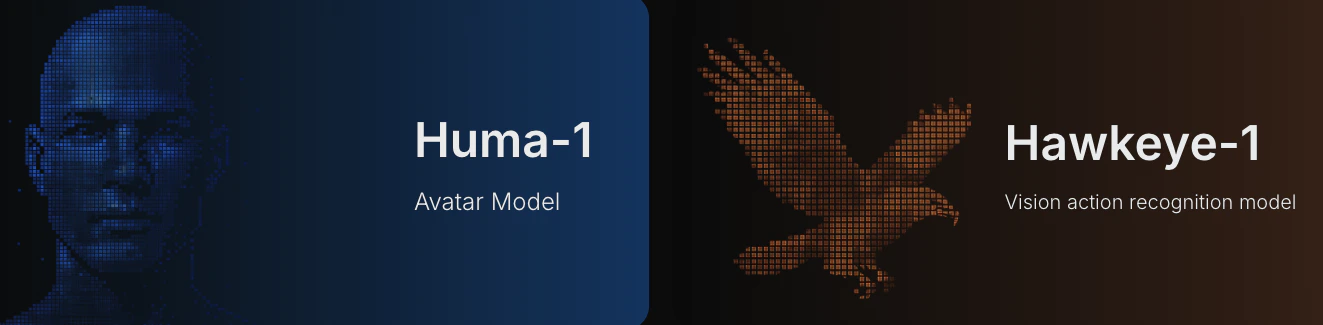 Huma-1 is TruGen's first-generation neural avatar renderer. It generates photorealistic video frames synchronized with speech, producing lifelike facial expressions, micro-expressions, lip sync, gaze direction, and emotional nuance in real time.
**Best for**
* Face-to-face conversational agents where realism matters
* Multi-language avatars that must maintain natural expression across accents
* Interactive product demos, interviews, coaching, and support experiences
**Key characteristics**
| Attribute | Detail |
| ------------------- | ------------------------------------ |
| Modality | Real-time video generation |
| Speech sync latency | ≤ 80 ms |
| Expression fidelity | Micro-expressions, gaze, head motion |
| Output | Streamed video frames |
## Hawkeye-1 — Vision Action Recognition Model
Hawkeye-1 is TruGen's vision layer. It continuously analyzes the user's video stream to understand appearance, environment, screen shares, and visual cues, feeding this context into the LLM so responses stay grounded in what the agent can actually see.
**Best for**
* Agents that must react to user actions (holding up a document, pointing at a screen)
* Multimodal experiences where context beyond audio matters
* Screen-share aware assistants and visual troubleshooting flows
**Key characteristics**
| Attribute | Detail |
| --------- | --------------------------------------------------- |
| Modality | Continuous vision perception |
| Input | Live user webcam, screen share |
| Output | Structured scene / action context passed to the LLM |
## How they work together
The models are complementary — Hawkeye-1 handles perception (what the agent sees), and the Huma family handles expression (how the agent responds), with Huma-2 pushing end-to-end latency into sub-500 ms territory. Combined with the pipeline's STT, LLM, and TTS stages, they enable agents that see, hear, understand, and respond with sub-second latency.
See how Huma-2, Huma-1, and Hawkeye-1 fit into the end-to-end conversational pipeline.
Spin up your first agent using these models.
Huma-1 is TruGen's first-generation neural avatar renderer. It generates photorealistic video frames synchronized with speech, producing lifelike facial expressions, micro-expressions, lip sync, gaze direction, and emotional nuance in real time.
**Best for**
* Face-to-face conversational agents where realism matters
* Multi-language avatars that must maintain natural expression across accents
* Interactive product demos, interviews, coaching, and support experiences
**Key characteristics**
| Attribute | Detail |
| ------------------- | ------------------------------------ |
| Modality | Real-time video generation |
| Speech sync latency | ≤ 80 ms |
| Expression fidelity | Micro-expressions, gaze, head motion |
| Output | Streamed video frames |
## Hawkeye-1 — Vision Action Recognition Model
Hawkeye-1 is TruGen's vision layer. It continuously analyzes the user's video stream to understand appearance, environment, screen shares, and visual cues, feeding this context into the LLM so responses stay grounded in what the agent can actually see.
**Best for**
* Agents that must react to user actions (holding up a document, pointing at a screen)
* Multimodal experiences where context beyond audio matters
* Screen-share aware assistants and visual troubleshooting flows
**Key characteristics**
| Attribute | Detail |
| --------- | --------------------------------------------------- |
| Modality | Continuous vision perception |
| Input | Live user webcam, screen share |
| Output | Structured scene / action context passed to the LLM |
## How they work together
The models are complementary — Hawkeye-1 handles perception (what the agent sees), and the Huma family handles expression (how the agent responds), with Huma-2 pushing end-to-end latency into sub-500 ms territory. Combined with the pipeline's STT, LLM, and TTS stages, they enable agents that see, hear, understand, and respond with sub-second latency.
See how Huma-2, Huma-1, and Hawkeye-1 fit into the end-to-end conversational pipeline.
Spin up your first agent using these models.